Wednesday, July 27, 2011

Transport Management: Bus Falls from Skyway Part 2 . . . How We Pay Truck Drivers & Accidents on the Road

Also similar to the previous post concerning Bus Falls from the Skyway, I want to bring up the situation of Truck Drivers in Manila which should be of concern to for how Logistic managers contract Trucking (or Cargo hauling) services in the Philippines:

1.  Truck drivers (working for Third-party trucking providers or haulers )are usually paid by the trip.

courtesy of AP/Patrick Reddy
2.  Provincial trips are paid a higher per trip rate and may or may not include an allowance for meals depending on umber of days to complete the delivery.

3.  Company-hired drivers are paid by the day or month with overtime pay in excess of 8 hours.  (For 3rd-party drivers, there is no such thing as fixed hours and OT pay.  Benefits are optional)

4.  Most manufacturers use 3rd-party trucking providers (as use of company-hired drivers is more expensive due to higher government-mandated wage rates & benefits as well as OT pay which outside truckers do not have to pay)

5.  Because Logistic managers of manufacturers pay haulers by the case or by the trip, the hauler also pays his driver by the trip.

6.  The hauler cannot pay monthly wages as there is no guarantee that the client-manufacturer or company will give him a daily trip.

7.  During lean months, the hauler will have to contend with idle trucks or trucks that deliver less-than-full truckload meaning his revenue may be at a loss if the number of cases paid for is less than his fuel and wages.

8.  The driver has to complete each trip in one day so that he can earn again the next day's trip.  If his trip takes more than 2 days, the hauler will only pay him once.

9.  Tendency then is for the driver to rush to finish his delivery.

10.  Also, in Manila we observe truck ban periods (no trucks on the road) from 5am to 7am and from 5pm to 9pm.  Hence, a driver that finishes his load has to wait for 9pm before he can go home i.e. maybe 10 to 11pm but has to be on the road again at 2 to 3am to avoid the truck ban at 5am.  Hence, he gets his sleep whenever the truck is waiting to be loaded or unloaded.

11. Drug usage (to keep awake) among drivers is always a problem for the hauler and Logistics manager.


For those interested in going into the Lotto Outlet business, I offer a One-on-One Consultation on How to Set-up and Operate Your Own Lotto Outlet.  Topics will include Site Selection, The Proper Way to Apply with the PCSO, How Much to Set-up a Lotto Outlet, Actual Operations, How to Attract Lotto Players, Hiring The Right Lotto Operator and How to Protect Your Business from Fraud and many many more.  I will share with you my Actual Experiences as a Lotto Agent.  My fee is only P2,000 per head.


 If you are interested in availing of my Lotto Consultation, you may text me at 0922-8831225 for details. See ya guys.
By the way, I would like to invite you to visit my Sulit Homepage as there are some business opportunities that you guys might be able to help me out with.  If you are interested, just click the Sulit Logo below:

My Sulit Homepage

Tuesday, July 26, 2011

Transport Management: Bus Falls from SkyWay (Interstate Overpass). 3 Dead. . . . . Does Management Care ?

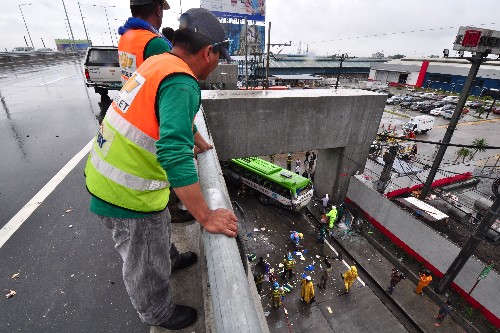
Today's News reported a loaded passenger bus that hit the guardrail of the Skyway (that would be your Interstate Overhead Freeway) and fell more than 40 feet below.  There was a report of 3  fatality which included the driver as well as injuries.  The bus was reportedly racing with another bus.
Bus falls from Skyway above.  3 dead.  (courtesy of the Alabang Bulletin)

Reading the comments on the Yahoo News blamed the driver for either speeding, recklessness and lack of driver training.  I think they miss the point and that is, the reason the drivers have to speed is because of the manner in which they are compensated:

  1.  Almost all drivers plyng Manila's main roads do not receive a fixed salary but instead get a commission based on the total fare revenue collected for the day;

  2.  This is aggravated further by the way this commission is computed.  A driver of a major bus company in Manila told me that the percentage rate of commission is on a graduated scale.  Example If the driver reaches P20,000 of total fare revenue for the day, he gets 10% but if he fails to reach P20,000, he only gets 8%.

  3.  While the intention of the bus company owner is to offer the 10% as an incentive, the driver understands it as a penalty i.e. if he does not reach P20,000, he loses 2%.

 4.  The 2% is a huge paycut for the driver as a typical driver works only 4 to 5 days a week (the other 3 to 4 days is for him to catch up with sleep)

5.  Because he is paid by commission with a penalty paycut, the tendency for the driver is to:

a.  Speed-up as he races against other drivers with the same paycut scheme

b.  The driver who narrated me how he is compensated admitted that he only gets 3 hours of sleep at best because he has to beat every other bus driver during rush hour crowd at 5am or earlier and ply the route till 2 - 3am just to make the P20,000.

c.  There may be lack of buses during rush hour, but there are so many empty and half-empty buses during off-peak hours that a driver has to race the main roads trolling for passengers.

d.  It is no surprise that there are reports of drivers on Shabu (or methamphetamine stimulant drug) or drinking a lot of energy drinks (Red bull, Cobra, Sting) with high caffeine just for them to stay awake!


Do not be surprised why there are so many accidents and deaths involving Manila buses, to wit:

1. The bus company owners do not care because in most cases, the driver cannot be found after a bus is involved in an accident.

2.  Some drivers told me that in an accident, it is better for the bus company that the passenger dies as compensation for death is a fixed amount unlike an injured passenger that may require medical treatment over a long period of time.

3.  Never sit on the empty seat on the right front side of the driver because in the event of an accident as when the bus will hit another bus or wall, the driver will always save himself by letting the right front of the bus hit the other bus or wall.


By the way, I would like to invite you to visit my Sulit Homepage as there are some business opportunities that you guys might be able to help me out with.  If you are interested, just click the Sulit Logo below:

My Sulit Homepage

Sunday, July 17, 2011

Which is Better, a Company-hired Employee or a Contract-based (Contractual) Worker?

Will I Regret Hiring You?  (courtesy of doitsolowithnolo.com)
When I was the Plant Administrative Services Manager of an Integrated Textile Mill south of Manila, I was in charge of a 1,200-man workforce of which about 300 were contract-based (contractual) workers and the rest were unionized regular (company-hired) employees. There lies the dilemna faced by many charged with managing a work force, to wit:

1.  In the Philippines, a contract-based or contractual worker must be regularized if his/her work tenure reaches 6 months of continuous work.  In almost all cases, contractual workers are let-go by the time their service reaches 5 months.

2.  In a skill-based industry such as a textile mill, our expatriate-technicians used to say it is a waste because the first month or two, the contract worker would just be learning the task \& hence exhibit high quality defects and just as she goes over the learning curve, she is laid-off.

3.  The unions have always condemned the use of contractual workers as this was a means to evade unionism (contractuals are not members of the union).

Company-hired or Contractual?  (courtesy of learnthat.com)
4.  When I asked our then Spinning mill manager where the bulk of the contractual workers were, it was mentioned that contractual workers are more conscientious with their work as they know that they can be let-go anytime if their performance do not meet company standards whereas regular workers tend to take their job for granted as they know they cannot just be removed from their jobs. (In my plant, we have 3 unions of which one of the unions calls themselves the February 21 Movement, a militant group of the Federation of Free Workers in the Philippines)

Of course, not all regularized employees are like that (I believe most regular employees care for their jobs especially as jobs are hard to come by) but one cannot help to play it safe and just bite the bullet (learning curve ills) & stick to contractuals.

Reach truck operator putaway of goods (courtesy of mhedcm.blogspot.com)
Take for example a Reach Truck or Forklift operator for a Logistic Distribution Center:

1.  The Reach Truck could cost upwards of P1.4 Million (USD 28,000);

Reach truck operator in a Warehouse
2.  Because operating a specialized equipment like a Reach Truck requires skills & years of experience, it is very difficult to hire good operators;

3.  A Reach truck operator would tend to know where all the SKUs are located in a Warehouse Racking System because of the day-in/day-out putaway/picking activities that he does & that has a very distinct bearing in the speed of storage or issuance of products;

4.  So, do I let-go of him after 5 months or not?

5.  Or do I just outsource the function and let the manpower agency worry about what to do with the reach truck operator if he turns out to be a "Bad Egg"?


By the way, I would like to invite you to visit my Sulit Homepage as there are some business opportunities that you guys might be able to help me out with.  If you are interested, just click the Sulit Logo below:
My Sulit Homepage


By the way, I am conducting a One-on-One Consultation on How to Setup and Operate Your Own Lotto Outlet.  Topics include How to Evaluate a Site for Lotto, The Proper Way to Apply with the PCSO, Actual Operations, How to Prevent Fraud, How to Compete Against Other Lotto Outlets and many more.  Please allot at least 2 hours for each session.  My fee is only P2,000 per person (Group discount available).  Just text me your full name and "Lotto Setup" to 0922-8831225 or call 514-2905 for details.

Acquiring a Lotto outlet is a lot cheaper than purchasing a Franchise from  Zagu (P320,000) or Siomai House (P250,000) and it is simple to operate. 

Latest news:  PCSO has lowered the Cash Bond requirement and an individual is now allowed to own 3 lotto outlets.

Saturday, July 9, 2011

Still Another Way to Steal Fuel From the Company -- The Sophisticated Way

When I was working for an Integrated Textile Mill south of Manila as their Plant Administrative Services manager, my department was in charge of receiving fuel deliveries for our 500,000-liter Bunker Tank as well as a smaller 45,000-liter Diesel tank.

Most oil companies like Shell, Calter/Chevron and Petron (Esso before) would employ third-party fuel tanker haulers to bring the fuel from the Pandacan Manila Oil Depots to our plant. And here is how the third-part fuel tanker operators steal our fuel:

Is there a hidden tank within the truck chassis?  (courtesy of afafueltrucks.com)
1.  Hidden within the fuel tank and towards the bottom of the truck chassis (or hidden between the chassis channel beams) is another fuel tank.  This tank is connected to the Main Tanker Tank thru a small pump.  The top hatch has a gauge to indicate the level of the fuel compartment as it was filled at the depot. As a procedure, our warehouseman will check that the fuel level is within the Gauge at top to make sure the tank is filled to capacity.

2.  Instead of a secret tank, the Main Tank is connected to the truck's fuel tanks thru a hidden pipe.

A fuel storage tank is as high as  a tall building. (courtesy of istockphoto.com)
When pumping starts, the driver will run the pump that will pump the fuel to our tanks.  At the same time, he secretly runs the other pump to pump fuel from the Main Tank to the hidden tank or to the truck's fuel tanks.

The driver makes sure always that the theft is small enough to fall within the tolerance (measurement margin of error) of  our huge Bunker tank even if the warehouseman conducts his sounding to determine the level of fuel that went into our tanks.  There is a margin of error because to take mearsurements, our warehouseman has to stand on top of the bunker tank which is as a high as a multi-storey building.  To take an accurate reading, the sounding tape scale has to be held perfectly vertical but with wind and height, the scale could be tilted slightly and that will already equal a couple of liters of fuel.

From the point of view of the manufacturing plant, their operating costs will go up. It is a Logistics concern from the point of view of the Fuel Tanker company in charge of the physical distribution of fuel -- Logistics is making sure the product arrives at Point B n accordance with the requirement of the client.


By the way, I would like to invite you to visit my Sulit Homepage as there are some business opportunities that you guys might be able to help me out with.  If you are interested, just click the Sulit Logo below:

My Sulit Homepage

Another Way to Steal Fuel from the Company -- The Traditional Way

1.  Driver requests petty cash of Pesos 1,500.00 to cover his trip for the day.

2.  Driver drives up to the company's authorized gas station and waits specifically to be loaded by his gas pump boy-accomplice.
Shouldn't that Gas be inside your Truck's fuel tank?  (courtesy of madsens 1.com)


3.  Gas pump boy-accomplice loads only Pesos 800 worth of fuel to the truck.

4.  The balance of Pesos 700 worth of fuel is loaded onto a fuel container.

5.  Gas pump-boy accomplice will later sell the fuel to other public transport vehicles that are owned by individuals like Jeepneys (common in Manila) and trucks that are owned by individuals and always willing to accept cheap fuel.

6.  Driver and gas pump boy-accomplice split the sales on his next trip.  And again , the cycle repeats itself.

How many Logistics or Transportation managers have a policy of spot-checking the fuel tank of trucks just after they fill-up with gas?

By the way, I would like to invite you to visit my Sulit Homepage as there are some business opportunities that you guys might be able to help me out with.  If you are interested, just click the Sulit Logo below:

My Sulit Homepage

The Problem with Fuel Cards As A Deterrent Against Fuel Pilferages

Shell Fleet Card (courtesy of Shell Philippines)
 Our Company maintains a fleet of about 39 20-ton Cargo Trucks delivering to all points in Metro Manila. Since Fuel is accounts for a significant portion of our Distribution  costs, the Management decided to enrol our trucks and drivers to the Fuel Card program offered by our Fuel supplier (Shell and Petron both have these programs).  This is how it works:

1.  The driver would present the Fuel Card to the gas pump boy before filling up.  The Gas pump boy would then swipe it in say Shell's swipe machine and this would message if the Fuel card is still valid or has been cancelled.  The gas boy is supposed to also check if the license plate of the truck conforms with the data on the Fuel card and to take note of the odometer reading of the truck.

2.  If ok, the gas boy then pumps the fuel.  When done, the gas purchase in liters and pesos are entered into the POS which will also capture the data on the Fuel card.

Is the fuel going to your truck, or somebody else's (courtesy of workitmom.com)
3.  At the end of the month, Shell or Petron would issue a monthly report to us showing:

a.  Plate number and driver name

b.  Distance travelled

c.  Total Fuel purchases (in pesos and liters)


d.  Kilometer per liter

 Based on the data of the kilometer per liter per truck , the company will know of a potential problem with the truck's fuel system or warn of possible fuel pilferage accounting for the high fuel consumption.

The problem is that the bulk of cargo trucks in the Philippines arrived as chop-chop units.  A Chop-chop means that the truck was chopped up to smaller pieces at the Point of Origin and imported as truck parts at a lower Customs duties rate. Things like speedometers and odometers are either not functioning or never checked for accuracy.

One solution suggested by a trucker friend of mine who has more than 100 trucks servicing Nestle Philippines:

Pumping dollars to the wind (courtesy of marinrealestate.com)
a.  All trucks are not allowed to load fuel elsewhere other than the Fuel Depot at the company's garage.

b.  Every trip of a truck is evidenced by a Trip Ticket prepared by the Dispatching Staff.  In it is contained the customers' names and general location (as in province or state). Another Staff would then compute the estimated distance to be travelled (based on a prepared kilometer distance template of all points of destination served by their trucks with their Main Garage as the Point of Origin).  The same Staff will also compute the amount of fuel to be loaded plus a certain allowance (based on the historical fuel consumption of each truck/engine combination).

c.  Driver presents the Trip Ticket to the Gas pump boy and fill-up the fuel.

d  If the truck should run out of fuel while along the way or on the way back, the driver is obliged to purchase fuel at his expense since there is already an inputted allowance.

By the way, I would like to invite you to visit my Sulit Homepage as there are some business opportunities that you guys might be able to help me out with.  If you are interested, just click the Sulit Logo below:

My Sulit Homepage

Fuel Theft by Company's Own Truck Drivers

Where did the gas go? (courtesy of imageenvision.com)
When I was with a Third-Party Logistics Provider or 3PL company as their Operations Manager, we had a fleet of about 39 20-tonner trucks delivering canned goods to Manila's supermarkets.  Since we work only on somewhat slim margins, Management watches keenly on its Operating Cost components and one of the most monitored would be Fuel.

We enrolled our trucks in our supplier's Fleet Card program wherein drivers were issued individual Fuel Cards which have to be presented to supplier's gas stations.  The Gasboy would then swipe the Fuel Card to capture data like date fuel was purchased, truck license plate number, driver name, amount of fuel, kilometer reading (optional) and fuel cost.

The idea is that a Monthly report will be submitted to us and we can see the total distance travelled, total fuel purchased and a kilometer per liter reading.  That last one is supposed to flag any unusual high fuel consumption to show of an engine problem or warn of possible fuel pilferage.

All fuel purchases were covered by computerized sales invoices issued by the gas station.  We had the proof when one of the gas invoices presented for reimbursement showed that payment was in the form of a Citibank credit card when in fact we provided petty cash to our drivers for all fuel purchases and these drivers do not have credit cards, let alone use it for a company purchase.

We brought the invoice in question to the attention of the gas station owner who called in the gas attendant whose name appears on the invoice.  The gas pump attendant confessed and this is how it happened:

1.  Our driver and the gas attendant where in cahoots.

Did you actually get the fuel that you paid for?(courtesy of sugarslam.com)
2.  Very few motorists bother to get their copy of the sales invoice.  Upon remitting payment, the cashier would give to the gas pump attendant the sales invoice and the change money.  After giving the change back to the motorist, the gas pump attendant would pocket the sales invoice if the motorist does not ask for it.

3.  When the driver accomplice comes, the gas attendant would look for an invoice of say P1,500 and give it to the driver.  No actual fuel was loaded.

4.  The driver would present the invoice as proof of purchase to our company's petty cash custodian.

5.  The driver and the gas boy divide the P1500 of fictitious purchase.

Of course, the driver would alternate between actual fuel purchase and the above.  The truck does not run out of fuel as our trucks have double-tanks and companies do not always check fuel consumption per truck versus actual distances travelled.

Logistics in its simplest form is planning and implementing the process to move the goods from Point A to Point B at the right time but just as important to the Logistics Manager is knowing HOW THE GOODS GOT THERE!!!


By the way, I would like to invite you to visit my Sulit Homepage as there are some business opportunities that you guys might be able to help me out with.  If you are interested, just click the Sulit Logo below:

My Sulit Homepage