Showing posts with label Pilferage. Show all posts

Saturday, July 9, 2011

Still Another Way to Steal Fuel From the Company -- The Sophisticated Way

When I was working for an Integrated Textile Mill south of Manila as their Plant Administrative Services manager, my department was in charge of receiving fuel deliveries for our 500,000-liter Bunker Tank as well as a smaller 45,000-liter Diesel tank.

Most oil companies like Shell, Calter/Chevron and Petron (Esso before) would employ third-party fuel tanker haulers to bring the fuel from the Pandacan Manila Oil Depots to our plant. And here is how the third-part fuel tanker operators steal our fuel:

Is there a hidden tank within the truck chassis?  (courtesy of afafueltrucks.com)
1.  Hidden within the fuel tank and towards the bottom of the truck chassis (or hidden between the chassis channel beams) is another fuel tank.  This tank is connected to the Main Tanker Tank thru a small pump.  The top hatch has a gauge to indicate the level of the fuel compartment as it was filled at the depot. As a procedure, our warehouseman will check that the fuel level is within the Gauge at top to make sure the tank is filled to capacity.

2.  Instead of a secret tank, the Main Tank is connected to the truck's fuel tanks thru a hidden pipe.

A fuel storage tank is as high as  a tall building. (courtesy of istockphoto.com)
When pumping starts, the driver will run the pump that will pump the fuel to our tanks.  At the same time, he secretly runs the other pump to pump fuel from the Main Tank to the hidden tank or to the truck's fuel tanks.

The driver makes sure always that the theft is small enough to fall within the tolerance (measurement margin of error) of  our huge Bunker tank even if the warehouseman conducts his sounding to determine the level of fuel that went into our tanks.  There is a margin of error because to take mearsurements, our warehouseman has to stand on top of the bunker tank which is as a high as a multi-storey building.  To take an accurate reading, the sounding tape scale has to be held perfectly vertical but with wind and height, the scale could be tilted slightly and that will already equal a couple of liters of fuel.

From the point of view of the manufacturing plant, their operating costs will go up. It is a Logistics concern from the point of view of the Fuel Tanker company in charge of the physical distribution of fuel -- Logistics is making sure the product arrives at Point B n accordance with the requirement of the client.


By the way, I would like to invite you to visit my Sulit Homepage as there are some business opportunities that you guys might be able to help me out with.  If you are interested, just click the Sulit Logo below:

My Sulit Homepage

Another Way to Steal Fuel from the Company -- The Traditional Way

1.  Driver requests petty cash of Pesos 1,500.00 to cover his trip for the day.

2.  Driver drives up to the company's authorized gas station and waits specifically to be loaded by his gas pump boy-accomplice.
Shouldn't that Gas be inside your Truck's fuel tank?  (courtesy of madsens 1.com)


3.  Gas pump boy-accomplice loads only Pesos 800 worth of fuel to the truck.

4.  The balance of Pesos 700 worth of fuel is loaded onto a fuel container.

5.  Gas pump-boy accomplice will later sell the fuel to other public transport vehicles that are owned by individuals like Jeepneys (common in Manila) and trucks that are owned by individuals and always willing to accept cheap fuel.

6.  Driver and gas pump boy-accomplice split the sales on his next trip.  And again , the cycle repeats itself.

How many Logistics or Transportation managers have a policy of spot-checking the fuel tank of trucks just after they fill-up with gas?

By the way, I would like to invite you to visit my Sulit Homepage as there are some business opportunities that you guys might be able to help me out with.  If you are interested, just click the Sulit Logo below:

My Sulit Homepage

The Problem with Fuel Cards As A Deterrent Against Fuel Pilferages

Shell Fleet Card (courtesy of Shell Philippines)
 Our Company maintains a fleet of about 39 20-ton Cargo Trucks delivering to all points in Metro Manila. Since Fuel is accounts for a significant portion of our Distribution  costs, the Management decided to enrol our trucks and drivers to the Fuel Card program offered by our Fuel supplier (Shell and Petron both have these programs).  This is how it works:

1.  The driver would present the Fuel Card to the gas pump boy before filling up.  The Gas pump boy would then swipe it in say Shell's swipe machine and this would message if the Fuel card is still valid or has been cancelled.  The gas boy is supposed to also check if the license plate of the truck conforms with the data on the Fuel card and to take note of the odometer reading of the truck.

2.  If ok, the gas boy then pumps the fuel.  When done, the gas purchase in liters and pesos are entered into the POS which will also capture the data on the Fuel card.

Is the fuel going to your truck, or somebody else's (courtesy of workitmom.com)
3.  At the end of the month, Shell or Petron would issue a monthly report to us showing:

a.  Plate number and driver name

b.  Distance travelled

c.  Total Fuel purchases (in pesos and liters)


d.  Kilometer per liter

 Based on the data of the kilometer per liter per truck , the company will know of a potential problem with the truck's fuel system or warn of possible fuel pilferage accounting for the high fuel consumption.

The problem is that the bulk of cargo trucks in the Philippines arrived as chop-chop units.  A Chop-chop means that the truck was chopped up to smaller pieces at the Point of Origin and imported as truck parts at a lower Customs duties rate. Things like speedometers and odometers are either not functioning or never checked for accuracy.

One solution suggested by a trucker friend of mine who has more than 100 trucks servicing Nestle Philippines:

Pumping dollars to the wind (courtesy of marinrealestate.com)
a.  All trucks are not allowed to load fuel elsewhere other than the Fuel Depot at the company's garage.

b.  Every trip of a truck is evidenced by a Trip Ticket prepared by the Dispatching Staff.  In it is contained the customers' names and general location (as in province or state). Another Staff would then compute the estimated distance to be travelled (based on a prepared kilometer distance template of all points of destination served by their trucks with their Main Garage as the Point of Origin).  The same Staff will also compute the amount of fuel to be loaded plus a certain allowance (based on the historical fuel consumption of each truck/engine combination).

c.  Driver presents the Trip Ticket to the Gas pump boy and fill-up the fuel.

d  If the truck should run out of fuel while along the way or on the way back, the driver is obliged to purchase fuel at his expense since there is already an inputted allowance.

By the way, I would like to invite you to visit my Sulit Homepage as there are some business opportunities that you guys might be able to help me out with.  If you are interested, just click the Sulit Logo below:

My Sulit Homepage

Fuel Theft by Company's Own Truck Drivers

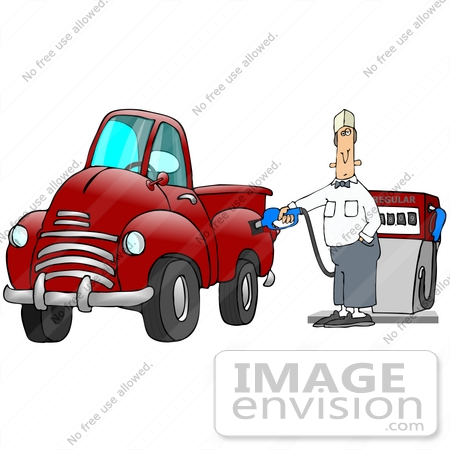
Where did the gas go? (courtesy of imageenvision.com)
When I was with a Third-Party Logistics Provider or 3PL company as their Operations Manager, we had a fleet of about 39 20-tonner trucks delivering canned goods to Manila's supermarkets.  Since we work only on somewhat slim margins, Management watches keenly on its Operating Cost components and one of the most monitored would be Fuel.

We enrolled our trucks in our supplier's Fleet Card program wherein drivers were issued individual Fuel Cards which have to be presented to supplier's gas stations.  The Gasboy would then swipe the Fuel Card to capture data like date fuel was purchased, truck license plate number, driver name, amount of fuel, kilometer reading (optional) and fuel cost.

The idea is that a Monthly report will be submitted to us and we can see the total distance travelled, total fuel purchased and a kilometer per liter reading.  That last one is supposed to flag any unusual high fuel consumption to show of an engine problem or warn of possible fuel pilferage.

All fuel purchases were covered by computerized sales invoices issued by the gas station.  We had the proof when one of the gas invoices presented for reimbursement showed that payment was in the form of a Citibank credit card when in fact we provided petty cash to our drivers for all fuel purchases and these drivers do not have credit cards, let alone use it for a company purchase.

We brought the invoice in question to the attention of the gas station owner who called in the gas attendant whose name appears on the invoice.  The gas pump attendant confessed and this is how it happened:

1.  Our driver and the gas attendant where in cahoots.

Did you actually get the fuel that you paid for?(courtesy of sugarslam.com)
2.  Very few motorists bother to get their copy of the sales invoice.  Upon remitting payment, the cashier would give to the gas pump attendant the sales invoice and the change money.  After giving the change back to the motorist, the gas pump attendant would pocket the sales invoice if the motorist does not ask for it.

3.  When the driver accomplice comes, the gas attendant would look for an invoice of say P1,500 and give it to the driver.  No actual fuel was loaded.

4.  The driver would present the invoice as proof of purchase to our company's petty cash custodian.

5.  The driver and the gas boy divide the P1500 of fictitious purchase.

Of course, the driver would alternate between actual fuel purchase and the above.  The truck does not run out of fuel as our trucks have double-tanks and companies do not always check fuel consumption per truck versus actual distances travelled.

Logistics in its simplest form is planning and implementing the process to move the goods from Point A to Point B at the right time but just as important to the Logistics Manager is knowing HOW THE GOODS GOT THERE!!!


By the way, I would like to invite you to visit my Sulit Homepage as there are some business opportunities that you guys might be able to help me out with.  If you are interested, just click the Sulit Logo below:

My Sulit Homepage

Saturday, July 2, 2011

Pilferage. Have You Checked the Areas Around Your Factory or Warehouse?

I was the Operations Manager for a Canned Fruit National Distribution Center located in the outskirts of Metro Manila.

We have gotten reports that Bad Order and Good stocks were being sold at very low prices among our neighborhood.

Bad stocks sold as Good Stocks (courtesy of freewebs.com)
Bad Orders are stocks that were delivered to the Trade (mostly Supermarkets) and subsequently returned to us as damaged goods, expired, rat-bitten and the like. Sometimes these Bad Order goods have their original shipping carton still in good condition and in the case of expired goods, even the tin cans still look in good condition.  Dented cans  will still be purchased by people especially if they are sold at a big discount.

To check it out, I had my warehouse supervisor visit the residential houses surrounding our Finished Goods Distribution Center as well as our Bad Order warehouse and to pose as a potential buyer of these damaged goods.

On his return, he reported that it was like a Home Industry as several residents were openly displaying and offering for sale said Bad Order goods.  Pretending to be a buyer, he entered one such house and was shown stocks of our products.  Holding some of the more or less good-condition cans, he noticed that they bore code-dates with long expired dates!

Source of the Bad Order cans:

1.  After delivering to the supermarkets and picking up the said Bad Order goods, our company drivers are supposed to proceed immediately to the Bad Order Warehouse to unload said Bad Order goods but instead, they would park a distance from the warehouse and offer these Bad Order goods to the residents.

2.  There is also the possibility that after receiving these Bad Order goods at the warehouse but before condemning same into the disposal dump, the Bad Order warehouse personnel would bring out these Bad Order goods for resale.

3.  Scrap buyers of the tin cans (in connivance with warehouse personnel) do not crush the filled Bad Order cans but instead bring them out as is for resale.

What would Food Poisoning do to your Brand? (courtesy of healthmad.com)
So next time, conduct periodic checks of the residents surrounding your factory or distribution warehouse for any sign of illegal reselling of your Bad Order stocks.

Imagine if an innocent buyer purchase such goods without knowing that they are Bad Order goods and his/her family suffer food poisoning, they would sue your Company!!! How about a situation wherein because of such incidents, the government will compel your Company to recall all of your products from the supermarket shelves?  How about permanent damage to your Company's Brand????


By the way, I would like to invite you to visit my Sulit Homepage as there are some business opportunities that you guys might be able to help me out with.  If you are interested, just click the Sulit Logo below:

My Sulit Homepage